
After the NSS 2025: What Really Threatens Europe’s Order And Which Options Remain
 ImpactNegotiating - 2ß25
After the NSS 2025: What Really Threatens Europe’s Order And Which Options Remain
Executive Summary
The United States National Security Strategy (NSS) of 2025 marks a strategic break in the post-1945 order: https://www.whitehouse.gov/wp-content/uploads/2025/12/2025-National-Security-Strategy.pdf
The document explicitly moves away from the idea that the United States will continue to carry the global system on its shoulders. It states that the age in which America supports the world order like Atlas is over, and that affluent allies should assume primary responsibility for their own regions. This is more than a budget argument. It is a structural shift in how Washington understands its role.
Europe no longer appears primarily as a partner. It appears as a problem case: economically stagnant, politically misdirected, and in a deep civilizational crisis. The NSS claims that economic decline is overshadowed by a darker prospect: the possible erasure of European civilization, driven by overregulation, uncontrolled migration, collapsing birth rates, restrictions on speech, and the loss of national identity. In this perspective, Europe is not the embodiment of Western values, but a warning example of what the United States believes it must avoid.
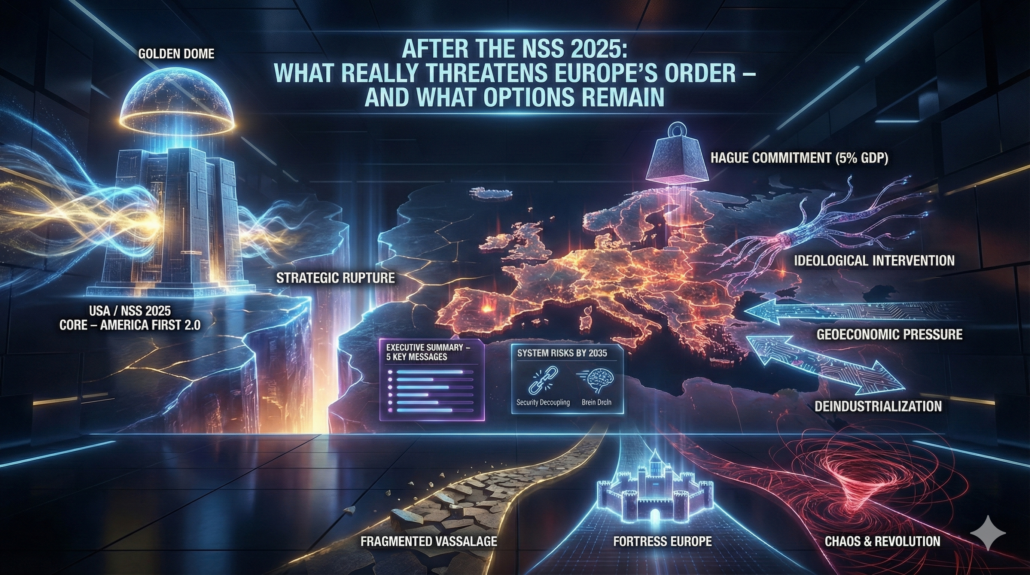
Out of this reading, the strategy outlines three operative levers toward Europe. The first is a drastic increase in expected defense spending through the so-called “Hague Commitment,” with a reference point of 5 percent of GDP for defense. The second is ideological intervention through explicit support for what the document calls “patriotic European parties,” combined with a harsh critique of many current European governments as weak, minority-based, and hostile to true democracy. The third is geo-economic pressure through energy policy, industrial policy, tariffs, financial leverage, and a direct attack on the European regulatory model.
From these elements arise three structural risk axes for Europe between now and roughly 2035. The first is security decoupling under conditions of continued dependency, as the United States withdraws parts of its presence from Europe while keeping formal commitments in place and prioritizing homeland protection. The second is political renationalization, driven both from within and by strategic encouragement from Washington, which could erode the supranational logic of the European Union. The third is geo-economic erosion through deindustrialization, sustained energy cost differentials, talent outflow, and loss of technological sovereignty.
The NSS 2025 functions, therefore, as an ultimatum and a stress test. It signals that the United States will provide security and economic partnership only within a hard, transactional framework that demands adaptation. Europe has a choice: accept a subordinate role in this framework or use the shock as a catalyst to define and build genuine strategic autonomy. The strategy is not an unavoidable fate. It is a forcing function that exposes how unfinished Europe’s own strategic project still is.
The Strategic Break
The NSS 2025 is not a technocratic planning paper. It is an explicitly political project. It defines American national interests narrowly: protection of the homeland, the economy, the industrial base, and a particular understanding of the American way of life. Everything that does not contribute directly to these priorities is downgraded. International institutions and transnational regimes are seen less as stabilizing structures and more as potential threats to sovereignty.
Burden shifting is at the core of this redefinition. Previous administrations have already complained about free riding. The difference now is that this complaint becomes an operative doctrine. The United States declares that it will no longer carry the system by default. Allies who benefit from American protection are expected to pay, align, and assume visible risk themselves. Security guarantees are no longer expressions of a shared identity, but outcomes of a cost-benefit calculation.
The “Golden Dome” concept amplifies this logic. The United States aims to build an advanced missile defense shield for the homeland. Whether this ambition is technically achievable in the announced time frame is an open question. Politically, the message is clear. Washington invests first in the invulnerability of its own territory and only in a second step in the stability of wider regions. This reverses the traditional logic of extended deterrence, in which the United States deliberately tied its security to that of allies in order to create credible mutual risks.
The New Judgment On Europe
The chapter on Europe carries the title “Promoting European Greatness.” At first glance, this sounds like an offer of support. The content, however, reads more like a strategic audit with a devastating verdict.
Economically, Europe is described as a continent that has lost momentum. The decline in Europe’s share of global GDP since the 1990s is interpreted not as a cyclical fluctuation, but as the result of structural errors. The NSS identifies national and supranational regulation as the main causes for this decline. According to this view, the European Union is not a modernizing powerhouse, but a bureaucracy that suffocates entrepreneurial energy.
The civilizational diagnosis goes further. The document claims that the economic downturn is overshadowed by the possibility of “civilizational erasure.” It links this to three factors: large-scale migration that transforms societies and fuels conflict, collapsing birth rates, and the erosion of national identities and civic self-confidence. The framing is not neutral. It resonates with right-wing narratives about demographic replacement, even if this specific term is not directly used. Thus, it places the core of contemporary European society-building under suspicion.
At the political level, many European governments are described as unstable minority governments that allegedly bend democratic rules in order to keep oppositional forces, especially those on the nationalist right, out of power. Mechanisms that are often understood in Europe as firewalls against extremism appear in the American text as suppression of legitimate opposition. In this reading, centrist coalitions in Berlin, Paris, or Madrid lose part of their moral legitimacy.
The strategic conclusion is obvious: The United States does not see itself as a neutral partner, but as an actor that should encourage resistance against the current European trajectory within European nations. “Patriotic European parties”—meaning national-conservative and EU-skeptic forces—are explicitly designated as bearers of hope. From the perspective of this strategy, they are not disruptors, but allies in a project of correcting Europe. The idea of a transatlantic community of values is thus effectively replaced by a policy aimed at reshaping Europe along the lines of a specifically American culture-war standard.
Military Architecture Under Pressure
The security policy linchpin of the NSS toward Europe is the “Hague Commitment.” It defines a new benchmark for defense spending by NATO states: 5 percent of Gross Domestic Product (GDP). The 2 percent target of recent years is thereby rhetorically devalued. It no longer appears as an ambitious target, but as an expression of underfunding.
For European welfare states, this creates a massive conflict of objectives. Five percent of GDP for defense implies fiscal upheavals of historic proportions for economies like Germany, Italy, or Spain. Without measures on the revenue side, such quotas can only be financed through cuts in social benefits, education, and public infrastructure. This weakens the social foundation of the very liberal democracies that are supposed to be stable partners. Political turmoil and waves of protest would provide additional support to extreme parties.
Furthermore, the European defense industrial base is fragmented and designed for a peace economy. Even if budgets were raised immediately, existing capacities could not absorb the demand quickly enough. In the initial phase, additional billions would highly likely flow into US weapons programs, from fighter jets to air defense systems. This strengthens the American Defense Industrial Base but undermines European industrial consolidation. Projects like a joint air combat system or a next-generation European tank come under pressure when short-term availability is politically valued higher than long-term sovereignty.
From this constellation, a “two-tier scenario” for NATO can be derived. States that meet US requirements and are politically aligned form an inner circle. They receive robust assurances, preferred access to technology, and possibly better trade conditions. States that cannot follow fiscally or politically fall into a gray zone. Formally, they remain alliance partners. In reality, they must expect that support in an emergency will be made dependent on current payments and political allegiance. The NSS does not explicitly formulate this hierarchy. But its logic enables and favors such a development.
Strategic Decoupling: Ukraine, Russia, And The Golden Dome
In dealing with the Russian war of aggression against Ukraine, the NSS 2025 sets a different focus than many European governments. It designates a swift end to hostilities as a core interest of the United States. As justification, it points to the economic stability of Europe, the limitation of escalation risks, and the restoration of strategic stability with Russia. Thus, the question of how the war ends is no longer posed primarily from the perspective of Ukrainian sovereignty, but from the viewpoint of systemic risk limitation.
Parallel to this, the document criticizes European elites who allegedly hold unrealistic expectations regarding the course of the war and suppress their populations’ readiness for a compromise peace. This creates the impression that Washington is prepared to push more strongly for a ceasefire, even if this misses Ukrainian maximal goals and freezes Russian territorial gains for the foreseeable future. For states on the Eastern Flank, especially Poland, the Baltic countries, and parts of Scandinavia, such a step would be difficult to accept. It would feed their concern that Moscow has effectively enforced part of its war aims while the Western alliance relativizes its principles.
Added to this is the effect of the “Golden Dome.” A successful American missile defense system that largely protects the homeland from ballistic threats changes risk perception. The safer Washington feels within its own territory, the more reserved it may become regarding the willingness to take maximum risks in the name of deterrence for others. At the same time, the temptation to act more decisively could grow because retaliatory strikes would primarily hit allies in the first line. From a European perspective, this logic is an alarm signal. It strengthens voices demanding a European nuclear “backstop” solution, either through a stronger Europeanization of French nuclear forces or through new multilateral arrangements.
Geo-Economic Offensive: Regulation, Energy, Trade
The NSS 2025 intertwines security and economic logic. Migration, energy, industrial policy, financial markets, and technology are not treated as separate fields, but as elements of a coherent approach to power.
In the area of migration, the strategy declares the era of mass immigration to be over. It emphasizes the security risks of open borders and links these to internal stability. At the same time, it opposes what it describes as an elite-driven curtailment of civil liberties, for instance in the context of free speech and the regulation of digital platforms. In European eyes, many of these measures are instruments to secure democratic discourse against hate and disinformation. In the American strategy, they appear rather as censorship mechanisms that suppress unwelcome political currents.
In energy policy, the NSS pursues an explicit strategy of dominance. The United States is to expand its role as a leading producer of oil, gas, coal, and nuclear energy. Climate policy, particularly “Net Zero” strategies, is portrayed as costly ideology that weakens competitiveness and benefits rivals. For Europe, whose Green Deal relies on rising CO2 prices, strict standards, and massive investments in decarbonization, this creates a structural disadvantage. Energy costs remain high, while the USA secures its industry with cheap fossil energy.
Reindustrialization is the third central building block. The NSS demands bringing supply chains back to the USA, building up industrial capacities, and using tariffs as well as trade policy instruments to correct imbalances. In a world where the United States might view not only China but also Europe as a source of overcapacity and unfair advantages, the German export model in particular comes under pressure. Tariff barriers against key sectors like automotive, mechanical engineering, or chemicals, combined with an aggressive energy and industrial site policy, would be toxic for many European business models.
Three Structural Risk Axes For Europe
From these developments, three robust axes of risk emerge.
The first is security decoupling amidst continued dependency. The USA signals that it links its presence in Europe to hard economic and political conditions. At the same time, it shifts resources toward homeland protection and other regions. For the foreseeable future, Europe remains dependent on American high-end capabilities, especially in strategic transport, air refueling, reconnaissance, and missile defense. If access to these capabilities becomes increasingly conditioned, a dangerous gap opens between formal alliance rhetoric and real capacity to act.
The second line of risk is political renationalization. If Washington treats national, EU-skeptic forces as preferred partners and openly criticizes supranational institutions, every domestic political debate in Europe takes on a transatlantic dimension. National governments might attempt to secure strategic advantages through closeness to the USA, even if this comes at the expense of European coherence. This increases the probability that central questions of EU policy will no longer be decided primarily according to European logic, but as a bet on American support.
The third axis of risk is geo-economic erosion. A permanent energy price disadvantage, combined pressure on industrial emissions, growing regulatory conflict with the USA, and the magnetic effect of American tech and financial markets create strong incentives for companies and talent to leave Europe. Particularly at risk are those sectors that combine high energy costs with high regulatory requirements, such as chemicals, the steel sector, and parts of the digital economy. If Europe does not develop a counter-strategy here, a creeping loss of value creation and innovative power threatens.
Scenarios For Europe’s Future
Against this background, three scenarios for Europe’s reaction can be sketched out. They are not predictions, but mental models that make options for action and risks visible.
In the Scenario of Fragmented Vassalage, the European Union fails to find a common line. Some states bind themselves closely to Washington, meet high defense requirements, orient their energy and industrial policy toward the American model, and receive privileged treatment in return. Others try to cling to previous models, come under economic pressure, and lose political influence. In this variant, the EU shrinks to a single market with residual competencies, while strategic decisions are made bilaterally between Washington and individual capitals.
In the Scenario of Fortress Europe, central member states use the external pressure as a catalyst. They drive forward the development of joint military capabilities, invest in a consolidated defense industry, strengthen the energy mix of renewable and nuclear sources, and develop a joint industrial and technological turnaround. Fiscal rules are adjusted so that security-relevant investments can be prioritized without destroying the social fabric. Europe defines itself confidently as an independent pole that cooperates with the USA but does not follow automatically, and is capable of setting its own priorities regarding China, Russia, and the Global South.
In the Scenario of Chaos and Revolution, the negative effects intensify. High energy and defense costs, trade conflicts, growing social tensions, and aggressive foreign policy rhetoric delegitimize existing governments. “Patriotic parties” take power in several core states. They use their position in the Council to dismantle EU competencies or block important decisions. Step by step, the Union loses its ability to act as a political entity. In this variant, Europe is rebuilt along a nationalist, deregulated logic that is closer to the ideology of the NSS than to the original integration project.
Strategic Options
These scenarios are not without alternatives. They illustrate that Europe’s room for maneuver depends on how early and how consistently politics and business react.
At the political level, the minimal option lies in a controlled adaptation. Europe accepts that the USA will no longer automatically act as the guarantor of last resort. At the same time, it works to build up capabilities specifically, rather than just working toward percentage figures. It uses dialogue formats to limit trade policy escalations and looks for areas where interests converge, such as critical raw materials, maritime security, or selected China topics.
A more far-reaching Sovereignty Strategy presupposes that member states dare to make a leap in integration in core fields. This means, among other things, a genuine European defense industry with a clear division of labor, stronger communitization of infrastructure, energy, and key technologies, as well as the expansion of European financial markets that can support investments in strategic projects without being exclusively dependent on the dollar area.
The Transformation Strategy finally aims to anchor Europe as an independent pole in a multipolar order. This includes targeted partnerships with states of the Global South, active shaping of global regulatory regimes, and the conscious decision to be a pioneer in specific fields, such as trustworthy artificial intelligence, sustainable industries, and dual-use technologies with high ethical standards.
For companies and financial actors, a clear mandate follows from this. They must integrate geopolitical developments as a structural factor into their strategy. This means systematically analyzing exposure to US and EU regulation, tariffs, sanctions, and energy prices. It means designing locations and supply chains so that they can react to different scenarios. And it means retaining talent by integrating them into projects that offer a genuine perspective in Europe, rather than serving merely as a stepping stone for careers in Silicon Valley.
Conclusion: The West After The West
The National Security Strategy 2025 is a radical text. It bids farewell to the fiction that the West is a homogeneous community of values in which all important actors share the same goals. Instead, it paints the picture of a world in which the United States defines and enforces its interests and in which even close allies appear primarily as variables in this equation.
Its thesis—that the political West as a unified entity no longer exists in the eyes of this administration—is therefore well-founded. It is crucial, however, not to confuse this diagnosis with a final state. In the USA itself, there are still strong forces interested in a cooperative, rules-based order. The NSS is the program of a specific political phase.
For Europe, the central question remains: Does the continent want to be a geopolitical actor with its own agenda, or a wealthy but vulnerable market in an order shaped by others? The NSS 2025 forces Europe to no longer postpone this question. Thus, within the harshness of the text, there also lies an opportunity. Europe can read from it how it is perceived, where it is vulnerable, and where it must expand its capabilities. The time of strategic illusions is over. What begins now is the phase in which it will be revealed whether Europe is ready to take itself seriously.