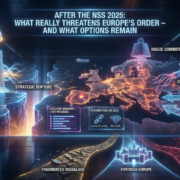
After the NSS 2025: What Really Threatens Europe’s Order And Which Options Remain

Executive Summary

The United States National Security Strategy (NSS) of 2025 marks a strategic break in the post-1945 order: https://www.whitehouse.gov/wp-content/uploads/2025/12/2025-National-Security-Strategy.pdf

The document explicitly moves away from the idea that the United States will continue to carry the global system on its shoulders. It states that the age in which America supports the world order like Atlas is over, and that affluent allies should assume primary responsibility for their own regions. This is more than a budget argument. It is a structural shift in how Washington understands its role.

Europe no longer appears primarily as a partner. It appears as a problem case: economically stagnant, politically misdirected, and in a deep civilizational crisis. The NSS claims that economic decline is overshadowed by a darker prospect: the possible erasure of European civilization, driven by overregulation, uncontrolled migration, collapsing birth rates, restrictions on speech, and the loss of national identity. In this perspective, Europe is not the embodiment of Western values, but a warning example of what the United States believes it must avoid.

Out of this reading, the strategy outlines three operative levers toward Europe. The first is a drastic increase in expected defense spending through the so-called “Hague Commitment,” with a reference point of 5 percent of GDP for defense. The second is ideological intervention through explicit support for what the document calls “patriotic European parties,” combined with a harsh critique of many current European governments as weak, minority-based, and hostile to true democracy. The third is geo-economic pressure through energy policy, industrial policy, tariffs, financial leverage, and a direct attack on the European regulatory model.

From these elements arise three structural risk axes for Europe between now and roughly 2035. The first is security decoupling under conditions of continued dependency, as the United States withdraws parts of its presence from Europe while keeping formal commitments in place and prioritizing homeland protection. The second is political renationalization, driven both from within and by strategic encouragement from Washington, which could erode the supranational logic of the European Union. The third is geo-economic erosion through deindustrialization, sustained energy cost differentials, talent outflow, and loss of technological sovereignty.

The NSS 2025 functions, therefore, as an ultimatum and a stress test. It signals that the United States will provide security and economic partnership only within a hard, transactional framework that demands adaptation. Europe has a choice: accept a subordinate role in this framework or use the shock as a catalyst to define and build genuine strategic autonomy. The strategy is not an unavoidable fate. It is a forcing function that exposes how unfinished Europe’s own strategic project still is.

The Strategic Break

The NSS 2025 is not a technocratic planning paper. It is an explicitly political project. It defines American national interests narrowly: protection of the homeland, the economy, the industrial base, and a particular understanding of the American way of life. Everything that does not contribute directly to these priorities is downgraded. International institutions and transnational regimes are seen less as stabilizing structures and more as potential threats to sovereignty.

Burden shifting is at the core of this redefinition. Previous administrations have already complained about free riding. The difference now is that this complaint becomes an operative doctrine. The United States declares that it will no longer carry the system by default. Allies who benefit from American protection are expected to pay, align, and assume visible risk themselves. Security guarantees are no longer expressions of a shared identity, but outcomes of a cost-benefit calculation.

The “Golden Dome” concept amplifies this logic. The United States aims to build an advanced missile defense shield for the homeland. Whether this ambition is technically achievable in the announced time frame is an open question. Politically, the message is clear. Washington invests first in the invulnerability of its own territory and only in a second step in the stability of wider regions. This reverses the traditional logic of extended deterrence, in which the United States deliberately tied its security to that of allies in order to create credible mutual risks.

The New Judgment On Europe

The chapter on Europe carries the title “Promoting European Greatness.” At first glance, this sounds like an offer of support. The content, however, reads more like a strategic audit with a devastating verdict.

Economically, Europe is described as a continent that has lost momentum. The decline in Europe’s share of global GDP since the 1990s is interpreted not as a cyclical fluctuation, but as the result of structural errors. The NSS identifies national and supranational regulation as the main causes for this decline. According to this view, the European Union is not a modernizing powerhouse, but a bureaucracy that suffocates entrepreneurial energy.

The civilizational diagnosis goes further. The document claims that the economic downturn is overshadowed by the possibility of “civilizational erasure.” It links this to three factors: large-scale migration that transforms societies and fuels conflict, collapsing birth rates, and the erosion of national identities and civic self-confidence. The framing is not neutral. It resonates with right-wing narratives about demographic replacement, even if this specific term is not directly used. Thus, it places the core of contemporary European society-building under suspicion.

At the political level, many European governments are described as unstable minority governments that allegedly bend democratic rules in order to keep oppositional forces, especially those on the nationalist right, out of power. Mechanisms that are often understood in Europe as firewalls against extremism appear in the American text as suppression of legitimate opposition. In this reading, centrist coalitions in Berlin, Paris, or Madrid lose part of their moral legitimacy.

The strategic conclusion is obvious: The United States does not see itself as a neutral partner, but as an actor that should encourage resistance against the current European trajectory within European nations. “Patriotic European parties”—meaning national-conservative and EU-skeptic forces—are explicitly designated as bearers of hope. From the perspective of this strategy, they are not disruptors, but allies in a project of correcting Europe. The idea of a transatlantic community of values is thus effectively replaced by a policy aimed at reshaping Europe along the lines of a specifically American culture-war standard.

Military Architecture Under Pressure

The security policy linchpin of the NSS toward Europe is the “Hague Commitment.” It defines a new benchmark for defense spending by NATO states: 5 percent of Gross Domestic Product (GDP). The 2 percent target of recent years is thereby rhetorically devalued. It no longer appears as an ambitious target, but as an expression of underfunding.

For European welfare states, this creates a massive conflict of objectives. Five percent of GDP for defense implies fiscal upheavals of historic proportions for economies like Germany, Italy, or Spain. Without measures on the revenue side, such quotas can only be financed through cuts in social benefits, education, and public infrastructure. This weakens the social foundation of the very liberal democracies that are supposed to be stable partners. Political turmoil and waves of protest would provide additional support to extreme parties.

Furthermore, the European defense industrial base is fragmented and designed for a peace economy. Even if budgets were raised immediately, existing capacities could not absorb the demand quickly enough. In the initial phase, additional billions would highly likely flow into US weapons programs, from fighter jets to air defense systems. This strengthens the American Defense Industrial Base but undermines European industrial consolidation. Projects like a joint air combat system or a next-generation European tank come under pressure when short-term availability is politically valued higher than long-term sovereignty.

From this constellation, a “two-tier scenario” for NATO can be derived. States that meet US requirements and are politically aligned form an inner circle. They receive robust assurances, preferred access to technology, and possibly better trade conditions. States that cannot follow fiscally or politically fall into a gray zone. Formally, they remain alliance partners. In reality, they must expect that support in an emergency will be made dependent on current payments and political allegiance. The NSS does not explicitly formulate this hierarchy. But its logic enables and favors such a development.

Strategic Decoupling: Ukraine, Russia, And The Golden Dome

In dealing with the Russian war of aggression against Ukraine, the NSS 2025 sets a different focus than many European governments. It designates a swift end to hostilities as a core interest of the United States. As justification, it points to the economic stability of Europe, the limitation of escalation risks, and the restoration of strategic stability with Russia. Thus, the question of how the war ends is no longer posed primarily from the perspective of Ukrainian sovereignty, but from the viewpoint of systemic risk limitation.

Parallel to this, the document criticizes European elites who allegedly hold unrealistic expectations regarding the course of the war and suppress their populations’ readiness for a compromise peace. This creates the impression that Washington is prepared to push more strongly for a ceasefire, even if this misses Ukrainian maximal goals and freezes Russian territorial gains for the foreseeable future. For states on the Eastern Flank, especially Poland, the Baltic countries, and parts of Scandinavia, such a step would be difficult to accept. It would feed their concern that Moscow has effectively enforced part of its war aims while the Western alliance relativizes its principles.

Added to this is the effect of the “Golden Dome.” A successful American missile defense system that largely protects the homeland from ballistic threats changes risk perception. The safer Washington feels within its own territory, the more reserved it may become regarding the willingness to take maximum risks in the name of deterrence for others. At the same time, the temptation to act more decisively could grow because retaliatory strikes would primarily hit allies in the first line. From a European perspective, this logic is an alarm signal. It strengthens voices demanding a European nuclear “backstop” solution, either through a stronger Europeanization of French nuclear forces or through new multilateral arrangements.

Geo-Economic Offensive: Regulation, Energy, Trade

The NSS 2025 intertwines security and economic logic. Migration, energy, industrial policy, financial markets, and technology are not treated as separate fields, but as elements of a coherent approach to power.

In the area of migration, the strategy declares the era of mass immigration to be over. It emphasizes the security risks of open borders and links these to internal stability. At the same time, it opposes what it describes as an elite-driven curtailment of civil liberties, for instance in the context of free speech and the regulation of digital platforms. In European eyes, many of these measures are instruments to secure democratic discourse against hate and disinformation. In the American strategy, they appear rather as censorship mechanisms that suppress unwelcome political currents.

In energy policy, the NSS pursues an explicit strategy of dominance. The United States is to expand its role as a leading producer of oil, gas, coal, and nuclear energy. Climate policy, particularly “Net Zero” strategies, is portrayed as costly ideology that weakens competitiveness and benefits rivals. For Europe, whose Green Deal relies on rising CO2 prices, strict standards, and massive investments in decarbonization, this creates a structural disadvantage. Energy costs remain high, while the USA secures its industry with cheap fossil energy.

Reindustrialization is the third central building block. The NSS demands bringing supply chains back to the USA, building up industrial capacities, and using tariffs as well as trade policy instruments to correct imbalances. In a world where the United States might view not only China but also Europe as a source of overcapacity and unfair advantages, the German export model in particular comes under pressure. Tariff barriers against key sectors like automotive, mechanical engineering, or chemicals, combined with an aggressive energy and industrial site policy, would be toxic for many European business models.

Three Structural Risk Axes For Europe

From these developments, three robust axes of risk emerge.

The first is security decoupling amidst continued dependency. The USA signals that it links its presence in Europe to hard economic and political conditions. At the same time, it shifts resources toward homeland protection and other regions. For the foreseeable future, Europe remains dependent on American high-end capabilities, especially in strategic transport, air refueling, reconnaissance, and missile defense. If access to these capabilities becomes increasingly conditioned, a dangerous gap opens between formal alliance rhetoric and real capacity to act.

The second line of risk is political renationalization. If Washington treats national, EU-skeptic forces as preferred partners and openly criticizes supranational institutions, every domestic political debate in Europe takes on a transatlantic dimension. National governments might attempt to secure strategic advantages through closeness to the USA, even if this comes at the expense of European coherence. This increases the probability that central questions of EU policy will no longer be decided primarily according to European logic, but as a bet on American support.

The third axis of risk is geo-economic erosion. A permanent energy price disadvantage, combined pressure on industrial emissions, growing regulatory conflict with the USA, and the magnetic effect of American tech and financial markets create strong incentives for companies and talent to leave Europe. Particularly at risk are those sectors that combine high energy costs with high regulatory requirements, such as chemicals, the steel sector, and parts of the digital economy. If Europe does not develop a counter-strategy here, a creeping loss of value creation and innovative power threatens.

Scenarios For Europe’s Future

Against this background, three scenarios for Europe’s reaction can be sketched out. They are not predictions, but mental models that make options for action and risks visible.

In the Scenario of Fragmented Vassalage, the European Union fails to find a common line. Some states bind themselves closely to Washington, meet high defense requirements, orient their energy and industrial policy toward the American model, and receive privileged treatment in return. Others try to cling to previous models, come under economic pressure, and lose political influence. In this variant, the EU shrinks to a single market with residual competencies, while strategic decisions are made bilaterally between Washington and individual capitals.

In the Scenario of Fortress Europe, central member states use the external pressure as a catalyst. They drive forward the development of joint military capabilities, invest in a consolidated defense industry, strengthen the energy mix of renewable and nuclear sources, and develop a joint industrial and technological turnaround. Fiscal rules are adjusted so that security-relevant investments can be prioritized without destroying the social fabric. Europe defines itself confidently as an independent pole that cooperates with the USA but does not follow automatically, and is capable of setting its own priorities regarding China, Russia, and the Global South.

In the Scenario of Chaos and Revolution, the negative effects intensify. High energy and defense costs, trade conflicts, growing social tensions, and aggressive foreign policy rhetoric delegitimize existing governments. “Patriotic parties” take power in several core states. They use their position in the Council to dismantle EU competencies or block important decisions. Step by step, the Union loses its ability to act as a political entity. In this variant, Europe is rebuilt along a nationalist, deregulated logic that is closer to the ideology of the NSS than to the original integration project.

Strategic Options

These scenarios are not without alternatives. They illustrate that Europe’s room for maneuver depends on how early and how consistently politics and business react.

At the political level, the minimal option lies in a controlled adaptation. Europe accepts that the USA will no longer automatically act as the guarantor of last resort. At the same time, it works to build up capabilities specifically, rather than just working toward percentage figures. It uses dialogue formats to limit trade policy escalations and looks for areas where interests converge, such as critical raw materials, maritime security, or selected China topics.

A more far-reaching Sovereignty Strategy presupposes that member states dare to make a leap in integration in core fields. This means, among other things, a genuine European defense industry with a clear division of labor, stronger communitization of infrastructure, energy, and key technologies, as well as the expansion of European financial markets that can support investments in strategic projects without being exclusively dependent on the dollar area.

The Transformation Strategy finally aims to anchor Europe as an independent pole in a multipolar order. This includes targeted partnerships with states of the Global South, active shaping of global regulatory regimes, and the conscious decision to be a pioneer in specific fields, such as trustworthy artificial intelligence, sustainable industries, and dual-use technologies with high ethical standards.

For companies and financial actors, a clear mandate follows from this. They must integrate geopolitical developments as a structural factor into their strategy. This means systematically analyzing exposure to US and EU regulation, tariffs, sanctions, and energy prices. It means designing locations and supply chains so that they can react to different scenarios. And it means retaining talent by integrating them into projects that offer a genuine perspective in Europe, rather than serving merely as a stepping stone for careers in Silicon Valley.

Conclusion: The West After The West

The National Security Strategy 2025 is a radical text. It bids farewell to the fiction that the West is a homogeneous community of values in which all important actors share the same goals. Instead, it paints the picture of a world in which the United States defines and enforces its interests and in which even close allies appear primarily as variables in this equation.

Its thesis—that the political West as a unified entity no longer exists in the eyes of this administration—is therefore well-founded. It is crucial, however, not to confuse this diagnosis with a final state. In the USA itself, there are still strong forces interested in a cooperative, rules-based order. The NSS is the program of a specific political phase.

For Europe, the central question remains: Does the continent want to be a geopolitical actor with its own agenda, or a wealthy but vulnerable market in an order shaped by others? The NSS 2025 forces Europe to no longer postpone this question. Thus, within the harshness of the text, there also lies an opportunity. Europe can read from it how it is perceived, where it is vulnerable, and where it must expand its capabilities. The time of strategic illusions is over. What begins now is the phase in which it will be revealed whether Europe is ready to take itself seriously.
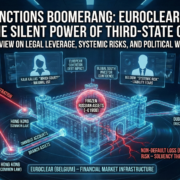
1. Why Euroclear Is Suddenly the Front Line of Geopolitics

From a negotiator’s perspective, the conflict over the frozen Russian central bank reserves is more than a technical sanctions dispute. It is a power struggle over who ultimately bears the expected “residual loss”: the EU member states, Belgium as the home state of Euroclear, or Euroclear itself as a systemically important financial market infrastructure. Kaja Kallas’s “famous” question – “Which court is Russia supposed to go to?” – suggests that Russia in practice has no effective legal remedies. Belgium, Euroclear and a growing number of practitioners, me included, see this very differently.

To understand why, we need to start with Euroclear’s ownership and functional structure.

2. Euroclear: Who Owns the “Plumbing” of the Global Financial System?

2.1 Ownership structure and role in the market

Euroclear is not a normal credit institution but the backbone of securities settlement. Euroclear Holding SA/NV in Belgium is the parent company and Euroclear Bank SA/NV is the operating bank based in Brussels, regulated by the National Bank of Belgium and embedded in EU regimes such as CSDR and EMIR. The majority shareholders are large financial institutions and market participants; in addition, there are national CSDs (for example Euroclear France and Euroclear Belgium) as group companies.

Euroclear Bank acts as an International Central Securities Depository (ICSD). It safekeeps securities with a volume of more than 40 trillion euros, processes bond, equity and fund transactions worldwide and provides collateral and cash management for banks, central banks and institutional investors. This makes Euroclear systemic: if something goes wrong here, it does not affect “a single bank” but the marketability of entire asset classes.

2.2 Global presence – and why Hong Kong and Dubai matter

Euroclear Bank SA/NV does not operate via separate legal subsidiaries, but through branches and representative offices. There is a branch in Hong Kong (a licensed bank under the supervision of the HKMA), further branches in places such as Krakow and Tokyo and representative offices in Dubai (DIFC), New York, Singapore and other locations.

The key point is that a branch is not a separate legal entity. The assets of the Hong Kong branch are assets of the Belgian Euroclear Bank SA/NV. An enforceable judgment against Euroclear can therefore in principle be enforced against branch assets in Hong Kong or other jurisdictions. This makes Hong Kong and, in a second step, Dubai interesting leverage points for third countries that do not support the EU sanctions architecture.

3. The Kallas Thesis vs. the Belgian Reality Check

3.1 Kallas: “Maximum use” – and the question “Which court?”

Since moving into the role of High Representative, Kaja Kallas has been the political figurehead of the “maximum use” line for the frozen Russian central bank funds. A significant share of the CBR reserves (around 185–190 billion euros) is held at Euroclear in Belgium. On this basis, a Ukraine “reparations loan” of around 140 billion euros is being constructed, economically “secured” by the immobilised reserves. Kallas argues under international law with the doctrine of countermeasures: a state that commits serious violations of international law cannot invoke full protection of its property in the same way.

Her notorious statement to EPP members of the European Parliament – in essence: “Which court is Russia supposed to go to? Which judge would ever rule in Russia’s favour here?” – is politically catchy at first glance, but in fact -ignores that Russia is no longer dependent on Western courts alone.

3.2 Belgium: “Fundamentally wrong” and “systemic risks”

Belgium, as the home state of Euroclear and its primary supervisory jurisdiction, is much more sober. Prime Minister Bart De Wever has described the Commission’s plans as “fundamentally wrong” and explicitly warned of systemic risks for the EU as a financial centre. Belgium sees two layers of exposure.

First, there is liability risk under the Belgium/Luxembourg–Russia BIT (1989), a bilateral investment treaty with classic guarantees against expropriation and unfair treatment. Second, there is balance sheet risk at the level of Euroclear itself, whose equity is in the single-digit billions while potential claims could be in the high double- or even triple-digit billions.

Belgium is therefore openly calling for EU-wide risk sharing and guarantees. Without a backstop provided by the EU, Euroclear would in practice become the solvency front line for a geopolitical decision taken in Brussels and Washington.

4. Anatomy of the Target: Balance-Sheet Logic, Omnibus Accounts and NDL Risk

4.1 The Russian “lump” in the Euroclear balance sheet

A single block now dominates the balance sheet of Euroclear Bank SA/NV. The total balance sheet amounts to around 220–230 billion euros, of which roughly 180–190 billion euros are immobilised Russian sovereign and central bank deposits. The interest earned on these deposits generates “extraordinary revenues” of several billion euros annually, which the EU now largely diverts to Ukraine.

From a negotiator’s point of view, this is not a side issue but a single point of failure in the bank’s balance sheet.

4.2 Omnibus structures: when one account holds thousands of investors

Many Euroclear positions in third countries are not held as segregated accounts, but via omnibus accounts at local central securities depositories or correspondent banks, such as the HKMA/Central Moneymarkets Unit, global banks in Hong Kong or Standard Chartered in the UAE. Legally, the underlying securities belong to the end investors, but at local account level they appear as a pooled position held in the name “Euroclear Bank”.

In an enforcement scenario, for example, a garnishment order against “all assets of Euroclear Bank in Hong Kong”, a court or a bank may initially attempt to block the entire balance until the individual ownership positions have been clarified. This is not automatic, but it is a pattern that has been observed in comparable custody situations. The consequence is that even a purely regional freeze in Hong Kong can temporarily shut down settlement for a large group of global clients – an operational heart attack before insolvency is even on the table.

4.3 Non-default loss: why legal judgments hit equity directly

Infrastructure regulation differentiates between two types of losses. Default loss is the loss from a participant default (for example a bank or broker). In such a case, waterfalls, margins and default funds apply. Non-default loss (NDL), by contrast, arises from other causes such as legal disputes, fraud or cyber incidents.

Judgments from Russian courts or arbitral awards based on the BIT clearly fall into the NDL category. They are not cushioned by default funds but flow directly through the profit and loss account and into equity. A damages award in the double-digit billions would clearly exceed the existing equity base and, without external recapitalisation, push Euroclear towards -technical insolvency. From a risk manager’s perspective, it is therefore almost inevitable that Belgium does not want to carry this burden alone.

5. Russia’s Lawfare: From a Moscow Judgment to a Global Lever

5.1 Article 248 APC – the “Lugovoy Law” as a legal weapon

With the introduction of Articles 248.1 and 248.2 of the Russian Arbitrazh Procedure Code in 2020, Moscow deliberately redrew the playing field. Russian courts declare themselves exclusively competent when sanctioned Russian parties are involved, even in the face of explicit arbitration clauses or foreign jurisdiction clauses. The rationale is that sanctions prevent Russian parties from having effective access to justice in the West, making Western jurisdiction clauses ineffective. The courts can issue anti-suit and anti-arbitration measures and can forbid companies such as Euroclear from pursuing proceedings abroad.

5.2 Judgments as an export product

More than one hundred proceedings are now pending against Euroclear before Russian courts; several banks and investors have already been awarded damages. The logic runs in four steps.

First, Russia generates enforceable judgments against Euroclear.

Second, there are hardly any attachable Euroclear assets in Russia itself, because the relevant Type-C accounts are also blocked.

Third, the judgments are therefore exported to Hong Kong, Dubai and other jurisdictions. Fourth, claimants attempt to “translate” them into local law and enforce them against branch assets or receivables.

The EU has recognised this dynamic and, with its fifteenth sanctions package, explicitly prohibited the recognition and enforcement of Lugovoy-based judgments within the EU.

This deliberately shifts the conflict into third countries.

6. Hong Kong: FSIL, Common Law and the Real Lever Against Euroclear

6.1 What the Foreign State Immunity Law (FSIL) actually changes

With China’s Foreign State Immunity Law, which has been in force since 1 January 2024, China has moved from absolute to restrictive state immunity. States and state entities no longer enjoy immunity for clearly commercial activities and enforcement against state assets used for commercial purposes is eased.

For any sound argumentation, three clarifications matter. FSIL is aimed primarily at states and state-related entities, not at private banks. For Euroclear, FSIL is only indirectly relevant, for example if Belgium or EU bodies were sued or subjected to enforcement measures in Hong Kong. The direct attack vector against Euroclear itself runs via classic common-law judgment enforcement and garnishee orders, not via state immunity.

6.2 Recognition of Russian judgments: obstacle or door opener?

Hong Kong remains a common-law court system, even though Beijing’s political influence is increasing. For the recognition of foreign judgments without a specific treaty, three conditions apply: the originating court must have had jurisdiction under Hong Kong standards, the judgment must be final and conclusive and it must not clearly violate public policy.

At the same time, Hong Kong positions itself as a “sanctions-neutral” financial centre. EU and US sanctions do not apply automatically and the courts have in several cases stopped Russian anti-suit manoeuvres and upheld arbitration agreements, even against sanctioned Russian banks.

For Euroclear this means that a Russian judgment could be recognised in individual cases, but the courts will examine very carefully whether Article 248 judgments themselves are abusive or overly political.

6.3 Practical access: branch capital, clearing accounts, omnibus structures

If a judgment is recognised, three types of assets are in focus in Hong Kong: the regulatory capital of the Hong Kong branch, accounts at the HKMA and other clearing banks and receivables of Asian institutions against Euroclear for fees and settlement cash.

An aggressive court could, at least temporarily, freeze balances, reroute payment flows or block specific settlement functions in the enforcement process. That is enough to trigger -a significant regional shock in Euroclear’s Asian business, even if the core of the Russian central bank deposits in Belgium remains untouched.

7. Dubai / DIFC: Reciprocity as a Flexible Lever

7.1 Dual court system and “conduit” risk

Dubai has a dual court system. Onshore courts operate in Arabic under civil law, while the DIFC Courts are common-law courts in English with an international profile. The DIFC is often used as a conduit jurisdiction: first an overseas judgment is recognised in the DIFC, then this DIFC judgment is enforced in the rest of Dubai.

For Russian creditors this is attractive because many international banks and payment flows are routed through the DIFC and because UAE courts are increasingly willing to recognise foreign judgments on the basis of de facto reciprocity.

7.2 Real but not yet tested danger

There are as yet no publicly documented cases in which a Lugovoy-based judgment against a major Western financial institution has been enforced in the DIFC. The danger is therefore potential rather than already realised.

For Euroclear, Dubai nonetheless represents a non-negligible lever, because it maintains a representative office in the DIFC, cash clearing in the UAE is partly provided by Standard Chartered and Russian and Gulf capital flows increasingly intersect there.

A garnishable setup would be, for example, receivables of MENA banks against Euroclear, such as fee income or reimbursement claims, which could be redirected to a Russian creditor on the basis of a court order.

8. The Belgium/Luxembourg–Russia BIT (1989): The Quiet but Powerful Lever

The bilateral investment treaty between Belgium/Luxembourg and the USSR/Russia (1989) is still in force and offers protection against expropriation and measures equivalent to expropriation, a fair and equitable treatment standard, free transfer of capital and returns and investor–state arbitration as an escalation channel. For Russian investors whose assets have been immobilised in Belgium via Euroclear, this is a legitimate legal basis to sue Belgium for indirect expropriation or unfair treatment and a way to obtain compensation through an arbitral award, even if the original assets remain frozen.

This shifts the risk from Euroclear to the level of the Belgian state, which in turn faces political pressure to share this risk via EU-wide guarantees.

9. What Courts in Hong Kong and Dubai Can – and Cannot – Do

From a negotiator’s standpoint, some clarifications are crucial. Courts in third countries cannot overturn EU sanctions or Belgian legislation. They have no jurisdiction to end the blockade of CBR balances in Belgium directly. What they can do, however, is recognise Russian judgments or arbitral awards, enforce them against local Euroclear assets or receivables and place banks and infrastructures in their jurisdiction in a conflict between local court orders and EU sanctions law.

Hong Kong and Dubai are therefore not switches that can unlock the frozen assets, but they are –amplifiers of pressure.

They can -significantly weaken Euroclear regionally and increase the cost of the sanctions regime for Europe.

10. A Negotiator’s View: Strategic Lessons Learned

From a negotiator’s perspective, five hard lessons emerge.

First, the Kallas question is wrongly framed.

The issue is not whether “a Western judge” will rule in favour of Russia, but how many non-Western courts and arbitral tribunals will give Russia a stage.

That number is -significant.

Second, Euroclear is in practice the liability front line of the EU. The combination of a massive Russia exposure, NDL logic and global branch and omnibus structures makes Euroclear the operational carrier of a political project whose risks have so far only been partially socialised at EU level.

Third, BIT plus lawfare plus third-country courts equals structural permanent pressure.

The Belgium/Luxembourg–Russia BIT, Article 248 APC and possible recognitions in Hong Kong and Dubai together form a robust toolkit with which Belgium and Euroclear can be drawn into legal conflicts for years.

Fourth, the real switches sit in Brussels, not in Hong Kong or Dubai.

The political switch is the Council of the EU, which can amend or repeal sanctions regulations.

The legal switch is the General Court and the Court of Justice of the EU, which can annul such acts in whole or in part.

The operational valves are the Belgian authorities, which can grant licences. Euroclear and the courts of third countries operate only within this framework.

Fifth, without explicit EU guarantees, the Ukraine loan is a solvency race.

The further the EU moves from temporary immobilisation towards effectively -illegally-confiscating Russian assets, the more important binding liability commitments for Belgium and Euroclear become, as well as clear communication towards investors from the Global South and a realistic recognition of the fact that courts in third countries are not a footnote but an independent power factor.

Otherwise, the bill for Brussels’ questionable actions will once again..

Explode in the pockets of EU citizens.

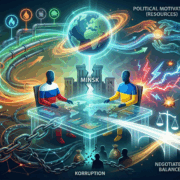
1. Why a Negotiator Must Look at Ukraine Differently Today

Anyone trying to understand today’s European policy toward Ukraine will not get far with moral categories alone. Terms such as “defending democracy,” “the rules‑based order,” or “the struggle of autocracy versus democracy” may be domestically useful, but they do not explain why European leaders continue to cling to the mantra “we will support Ukraine for as long as it takes,” even as the military situation steadily tilts in Russia’s favor.

The balance of power at the front has been shifting continuously: Russia now controls a little over 19% of Ukraine’s territory, has made further, albeit limited, gains in 2025, especially in the Donbas and is exerting massive pressure around key nodes such as Pokrovsk. The Ukrainian armed forces are suffering from manpower and ammunition shortages and have had to retreat on several sectors of the front, while Russia, despite its own losses, maintains a strategy of slow, grinding advance. Western analysts note that although Russia conquered less than 1% of additional territory in 2025, Putin interprets these incremental movements as confirmation of a long‑term attritional strategy.

For professional negotiators this implies a clear logic: Ukraine’s BATNA (Best Alternative to a Negotiated Agreement) worsens every day; Russia’s BATNA improves steadily. Russia is, with ruthless consistency, achieving the declared objectives of its “special military operation,” and yet many European actors continue to insist on surreal maximalist demands and a support regime designed for the long haul. To understand this apparent paradox, three deep layers must be considered together:

  • The Minsk agreements as a blueprint and as a deterrent template for today’s ceasefire debates.
  • Nord Stream, raw materials and geo‑economics as the engine of Europe’s Ukraine policy.
  • Corruption as a continuous vulnerability. From oligarchic political economy to today’s energy scandals and as a lever of hybrid conflict strategy.

Only through this triangulation does it become understandable why European policy sometimes appears detached from battlefield facts—indeed “mad”—while at the same time following an internal political and geo‑economic logic in certain circles. The horrific human losses remain, cynically, almost ignored.

2. Understanding Minsk Correctly — From Peace Plan to Lever of Influence

2.1 What Minsk I and II Formally Were

The Minsk agreements of 2014 (Minsk I) and 2015 (Minsk II) were essentially designed as a two‑level package:

  • Security level: immediate ceasefire, withdrawal of heavy weapons, creation of security zones, OSCE monitoring.
  • Political level: a “special status” for parts of the Donetsk and Luhansk regions, amnesty provisions, local elections under Ukrainian law and subsequent restoration of Ukraine’s control over its state border.

On paper this reads like a classic sequencing model: first de‑escalation, then reintegration. The UN Security Council even endorsed Minsk II through Resolution 2202 (2015), giving the agreements considerable formal weight.

2.2 Why Minsk Was Structurally Doomed to Fail

Chatham House captured the core problem crisply: the agreements rested on a “Minsk conundrum”—the irreconcilable question of whether Ukraine may be fully sovereign or must accept a limited sovereignty co‑defined by Russia.

  • Kyiv’s reading: ceasefire → Russian withdrawal → restoration of border control → then local elections and limited decentralization.
  • Moscow’s reading: immediate special status, de facto veto rights for the separatist territories and a form of “soft federalization” before Kyiv regains border control.

These opposing sequences made Minsk practically impossible to implement. In addition, the ceasefire never truly held; the battles around Debaltseve in February 2015, already after signature, illustrate how little the military reality matched the negotiation text.

2.3 Minsk as a Textbook Case of Hybrid Conflict Strategy

The later‑published “Surkov Leaks”, hacked emails from the environment of Vladislav Surkov, a key architect of Russia’s Ukraine policy, show how Moscow, in parallel to Minsk, systematically financed and steered local parties, NGOs, media campaigns and “protest formats” inside Ukraine.

Minsk therefore constituted part of a broader hybrid approach:

  • military: controlled escalation in the Donbas;
  • political: forcing structural veto rights for pro‑Russian actors;
  • informal: building a network of dependent elites, media outlets and NGOs.

Carnegie’s retrospective judgment is clear: Minsk phased down fighting at times, but neither prevented Russia’s full‑scale invasion in 2022 nor the long‑term militarization of the conflict.

2.4 The Lesson for Any Ceasefire Debate Today

Current expert debates about potential new arrangements—often shorthand as “Minsk III”—are shaped by that experience:

Any arrangement that grants Russia territorial gains and political leverage without simultaneously embedding robust security guarantees, effective monitoring and sequencing favorable to Ukraine will, with high probability, again be used as a pressure instrument.

For negotiators, the takeaway is blunt: a frozen conflict without enforceable security architecture is not a stable compromise, it is a platform for the next escalation cycle.

3. Nord Stream and Raw Materials — Geo‑economics as a Hidden Driver

3.1 Nord Stream as a Political Instrument, Not Just Infrastructure

Nord Stream 1 and 2 were never merely technical pipelines; they were strategic projects. They bypassed Ukraine as a transit country and tied German industry directly to Russian gas. Think tanks such as Brookings and several European security institutes warned early on that Nord Stream 2 was less a business project and more an instrument to “weaponize” energy and weaken Ukraine.

After 2022, Nord Stream 2 was politically halted and later physically damaged by sabotage. Clean Energy Wire described the pipeline in retrospect as a symbol of Germany’s failed bet on cheap Russian energy. The strategic lesson: energy policy is power politics—and transit countries like Ukraine are integral to security calculations.

This becomes particularly evident in the historical and current corruption cases.

3.2 Ukraine as a Raw‑Material Hub for Europe’s Future Industries

In parallel, the EU has been reshaping its raw‑materials policy to reduce dependence on China for critical inputs. A key building block is the Strategic Partnership on Raw Materials with Ukraine, signed in July 2021.

EU analyses and World Economic Forum studies emphasize:

  • Ukraine holds deposits of 22 of the 34 materials the EU classifies as “critical,” including lithium, graphite, rare earths and titanium.
  • Many of these deposits lie in the East and South—regions Russia already controls or is heavily attacking. Media and think tanks reported in 2023/24 that Russia has occupied important lithium deposits in Donetsk.

For Europe’s battery, aerospace and defense industries this geography is highly relevant: whoever controls these deposits holds leverage over the entire value chain of the Green Deal and substantial parts of the defense supply base.

3.3 Geo‑economic Implications

From a negotiation perspective, this means: in any sustainable conflict settlement, the control, development and regulation of these raw materials will be central—even if rarely mentioned in public discourse.

For European actors, a scenario in which Russia permanently controls a large share of these deposits is strategically unacceptable. Hence the strong incentive to support Ukraine at least until a political solution secures these geo‑economic interests—or alternative supply chains are built. In my view, this could be negotiated with Russia far more intelligently.

4. Corruption as Continuum — From “Rotterdam+” to Operation “Midas”

Ukraine’s political economy has for decades been shaped by oligarchic rent systems and regulatorily enabled windfall profits. This is not accidental; it constitutes a structurally exploited entry point for hybrid conflict strategy.

4.1 Rotterdam+ — How a “Technical” Model Became Political

Between 2016 and 2019 Ukraine used the Rotterdam+ formula to set the price of hard coal for power generation. Officially, it was meant to create transparency and reflect an import‑parity price:

  • The base was the average spot price for power‑station coal in the Amsterdam–Rotterdam–Antwerp (ARA) ports over the previous twelve months.
  • Added to this were fictitious logistics costs: sea transport from Rotterdam to a Ukrainian port, transshipment costs and rail transport to the power plant—regardless of whether the coal actually traveled that route.

In practice, this meant:

  • The regulator applied the relatively high derived reference price to almost the entire relevant coal volume, around 25.5 million tons per year, even though only about 130,000 tons were actually imported via Rotterdam.
  • A large share of coal was in fact sourced from Ukrainian mines, from the Donbas, or imported cheaply from Russia -with far lower real production and transport costs.

The consequence: electricity tariffs were calculated on the basis of an artificially inflated “Rotterdam reference price plus.” Oligarch‑linked generators, especially DTEK owned by billionaire Rinat Akhmetov, captured substantial additional profits, while households and industry paid higher prices. Anti‑corruption organizations and the Specialized Anti‑Corruption Prosecutor’s Office estimate the potential damage to consumers and the state at roughly 38–39 billion hryvnia.

Even though the case remains legally contested and politically charged, Rotterdam+ illustrates vividly:

  • how technical regulatory formulas can be turned into rent‑extraction machines;
  • how oligarchs and decision‑makers can profit jointly from that machine;
  • how such structures undermine state resilience and make the country maximally vulnerable to targeted external influence.

4.2 Continuity Under Conflict Conditions: Operation Midas

Today, amid the conflict, Ukraine is confronting Operation “Midas,” the largest corruption scandal since the beginning of Russia’s “special military operation.” NABU and the Specialized Anti‑Corruption Prosecutor’s Office uncovered a kickback system around the state nuclear power operator Energoatom.

Key features:

  • Contractors had to pay systematic kickbacks of 10–15% of contract value (“toll‑gate model”) to retain contracts or obtain payments.
  • The system functioned as a high‑level organized structure; NABU speaks of a “high‑level criminal community” in the energy and defense sectors that allegedly siphoned around 100 million USD.
  • The suspected ringleader is businessman Tymur Mindich, a long‑time partner of President Zelenskyy. Extensive audio recordings exist; Mindich has fled.

The political blast radius is immense:

  • President Zelenskyy was compelled to dismiss the energy minister and the justice minister and to announce a sweeping purge in the energy sector.
  • EU partners and neighbors, such as Poland’s prime minister, demand “zero tolerance,” because scandals of this magnitude directly undermine Ukraine’s EU accession credibility.

From the standpoint of hybrid conflict strategy, one point is striking: Russian propaganda uses Midas and similar cases aggressively to reinforce the narrative—often accurate in its core—that Ukraine is hopelessly corrupt and therefore an unreliable partner.

4.3 Corruption as a Strategic Weak Point in Hybrid Conflict

The continuity from oligarch‑dominated energy corruption before 2022 (Rotterdam+) to Midas today shows:

  • actors may change; incentives remain.
  • high margins in regulated markets (energy, infrastructure, defense) systematically generate temptation for insider networks.
  • for Russia this vulnerability is doubly attractive:
    • it creates real weaknesses (under‑investment, inefficient procurement, reduced defense capacity);
    • and it provides legitimizing material to politically erode Western support (“why should we pay for this corrupt system?”).

Anyone thinking about negotiations on security guarantees, reconstruction funds, or energy reforms must recognize: without a hard, enforceable anti‑corruption architecture, any political settlement will rest on unstable ground.

5. The Current Conflict Situation — Power Balance, Time Factor and Sunk Costs

5.1 The Military Picture at the End of 2025

In condensed form, the situation looks like this:

  • Russia occupies about one‑fifth of Ukraine and has made further gains in the East in 2025; around Pokrovsk, intense advances are underway, including urban fighting.
  • The front, over 1,000 km long, has turned into a technologically saturated positional conflict: drones, precision artillery and electronic warfare dominate; Russian forces increasingly use infiltration teams in poor weather to breach Ukrainian lines.
  • Russia continues massive missile and drone campaigns against Ukraine’s energy system. Late‑November waves caused severe damage to power plants and infrastructure, producing nationwide blackouts.
  • Despite pressure, Ukrainian units have so far held key cities such as Pokrovsk, conducted counterattacks and use drones to disrupt Russian supply lines.

Western assessments are notably ambivalent: Russia is strategically weakened and pays a huge blood price for small territorial advances, yet many argue that without sustained Western support Ukraine may, over time, lose the ability to hold key nodes.

For professional negotiators the core variable is time. Russia calculates that a long conflict will erode Western backing; Ukraine must endure each month under air attacks while preserving defense capability and internal stability.

5.2 Sunk Costs and Political Self‑binding

Western leaders are now deeply self‑bound to their Ukraine policy:

  • Ursula von der Leyen has made support for Ukraine a defining benchmark of her presidency, openly warning that a Ukrainian failure would weaken both Europe and the U.S.
  • Baltic leaders view Ukraine as a buffer zone; every resource consumed there is a resource not used against Tallinn or Riga.
  • In Berlin, Paris and London the conflict acts as a catalyst for overdue defense reorientation and for building a European arms industry whose new production lines require long‑term utilization.

This creates a bizarre but classic sunk‑cost lock‑in: the more political capital, budget and reputation already invested, the harder it becomes to step back from maximalist goals.

What many citizens perceive as “Russophobia” or “denial of reality” can therefore be read as an attempt to defend a bundle of geo‑economic aims, security self‑assertion and political credibility—though, factually, this trajectory is increasingly untenable and humanly intolerable.

6. Negotiation Alternatives — How a Professional Negotiator Reads This Situation

A negotiator must consider not only normative questions (“what would be just?”) but hard parameters:

  • relative power positions;
  • time preferences;
  • domestic political constraints;
  • structural levers (energy, raw materials, capital, sanctions);
  • and shadow negotiations over corruption networks, oligarchic assets and security guarantees.

From this angle, three alternatives can be sketched, each with distinct risk profiles.

6.1 Alternative A: Armed Ceasefire with Hard Security Architecture

Logic: Acknowledge the military reality of a frozen but asymmetric conflict while maximizing security guarantees for Ukraine.

Possible components:

  • De facto fixing of frontlines with demilitarized zones and strong international monitoring (OSCE‑plus, a UN mandate, or a new mission).
  • Phased, conditional easing of selected sanctions on Russia tied to measurable compliance indicators (withdrawal of certain systems, inspections, cessation of specific missile strikes).
  • Security guarantees for Ukraine outside formal NATO membership, e.g., bilateral defense treaties with the U.S. and core EU states, with clearly defined response mechanisms if escalation resumes.

Risks:

  • Russia could use the ceasefire as an operational pause, similar to 2015–2022. In my view, Russia has no interest in that now.
  • Ukraine may perceive such an arrangement as “rewarding aggression,” triggering high domestic destabilization risk.

Negotiation challenge: Design sequencing and enforcement so that real costs for violations are automatic, not merely politically announced.

6.2 Alternative B: Resources‑and‑Security Deal

Logic: Explicitly integrate geo‑economic interests into a comprehensive arrangement.

Possible models (if Ukraine remains state‑capable):

  • Joint, internationally monitored exploitation of selected raw‑material fields with clear revenue‑sharing.
  • Linking resource access to binding security arrangements (e.g., limited Russian presence in defined zones in exchange for guaranteed export of certain materials at market prices).

These constructs are legally and politically demanding, but they reflect actual incentives more realistically than moral narratives alone.

6.3 Alternative C: Long‑term Containment without a Formal Grand Agreement

Logic: Accept that no comprehensive, durable deal is reachable with the current Russian leadership.

Elements:

  • continued military support for Ukraine but with more realistic, defensive aims (protect core territory over full reconquest);
  • a long‑term containment strategy against Russia akin to the Cold War, including sanctions, export controls and systematic diversification of energy and raw‑material supply chains;
  • parallel construction of a robust anti‑corruption and governance architecture in Ukraine to make it EU‑compatible regardless of battlefield dynamics.

This option essentially continues the status quo, but with a clearer strategic frame. Humanitarian costs are highest; geopolitically it becomes “managed instability.”

7. What Professional Negotiators Can Take from This Case

Beyond geopolitics, Ukraine offers core lessons for complex negotiations in business, politics and organizations:

  1. Analyze interests, not rhetoric. Moral frames mask concrete drivers: raw materials, industrial value creation, domestic stability, sanctions architecture.
  2. Treat time as a negotiation variable. Russia, Ukraine and the EU have different time preferences. Sequencing must reflect that asymmetry.
  3. Think in shadow negotiations. Corruption systems like Rotterdam+ and Midas define real levers more than formal committees.
  4. Manage sunk costs actively. Exit scenarios and face‑saving bridges must be built early so actors do not trap themselves in “no alternative” narratives.
  5. Hybrid conflicts require hybrid negotiation designs. Energy, raw materials, anti‑corruption and information policy must be integrated into one architecture.

Appendix: Selected Sources by Theme

(1) Minsk Agreements, Ceasefire Architecture, Hybrid Warfare

  • Wikipedia: Minsk agreements — overview of Minsk I and II, core elements and implementation.
  • Federal Agency for Civic Education (bpb): The Minsk Agreement of February 12, 2015 — full text and context.
  • Chatham House: The Minsk Conundrum: Western Policy and Russia’s War in Eastern Ukraine — analysis of the structural contradiction.
  • Carnegie Endowment: In the Shadow of the Minsk Agreements: Lessons for a Potential Ukraine‑Russia Armistice — lessons for future ceasefires.
  • DFRLab / RUSI: Analyses of the Surkov Leaks — Kremlin role in steering separatist regions and “soft federalisation.”

(2) Nord Stream, Energy Policy, Critical Raw Materials

  • Brookings Institution: Nord Stream 2: Background, objections and possible outcomes — geopolitical risks.
  • Clean Energy Wire: Nord Stream 2 – symbol of a failed German bet on Russian gas — energy‑policy assessment.
  • European Commission: EU and Ukraine kick‑start strategic partnership on raw materials — 2021 MoU and critical‑material role.
  • WEF / European Parliament / think tanks: studies on Ukrainian lithium, graphite and rare‑earth relevance for the Green Deal.

(3) Corruption, Rotterdam+ and Operation Midas

  • HACC / Transparency International Ukraine: Rotterdam+ case — damage assessment and judicial status.
  • ANTAC / Hromadske: Rotterdam+ formula — mechanics of the formula, beneficiaries and critique.
  • NABU: Operation Midas — official disclosure of the scheme.
  • Reuters, Guardian, Euronews: coverage of Midas, personnel consequences in the energy sector and political impact.